By Miguel Pacheco, SAP Principal Engineer, Foulk Consulting
When IT leadership thinks about SAP risk, they usually envision the titans: a massive S/4HANA migration, a global instance consolidation, or a major cloud infrastructure lift-and-shift. These projects command multi-million dollar budgets, dedicated war rooms, and months of meticulous planning. Because they are visibly risky, they get the resources they need to succeed.
But there is a quieter, far more insidious driver of operational downtime hiding in plain sight.
It lives in your weekly transport queues. It is wrapped inside routine support packages, quarterly updates, and standard enhancement packs. It is what organizations comfortably classify as “Business as Usual” (BAU).
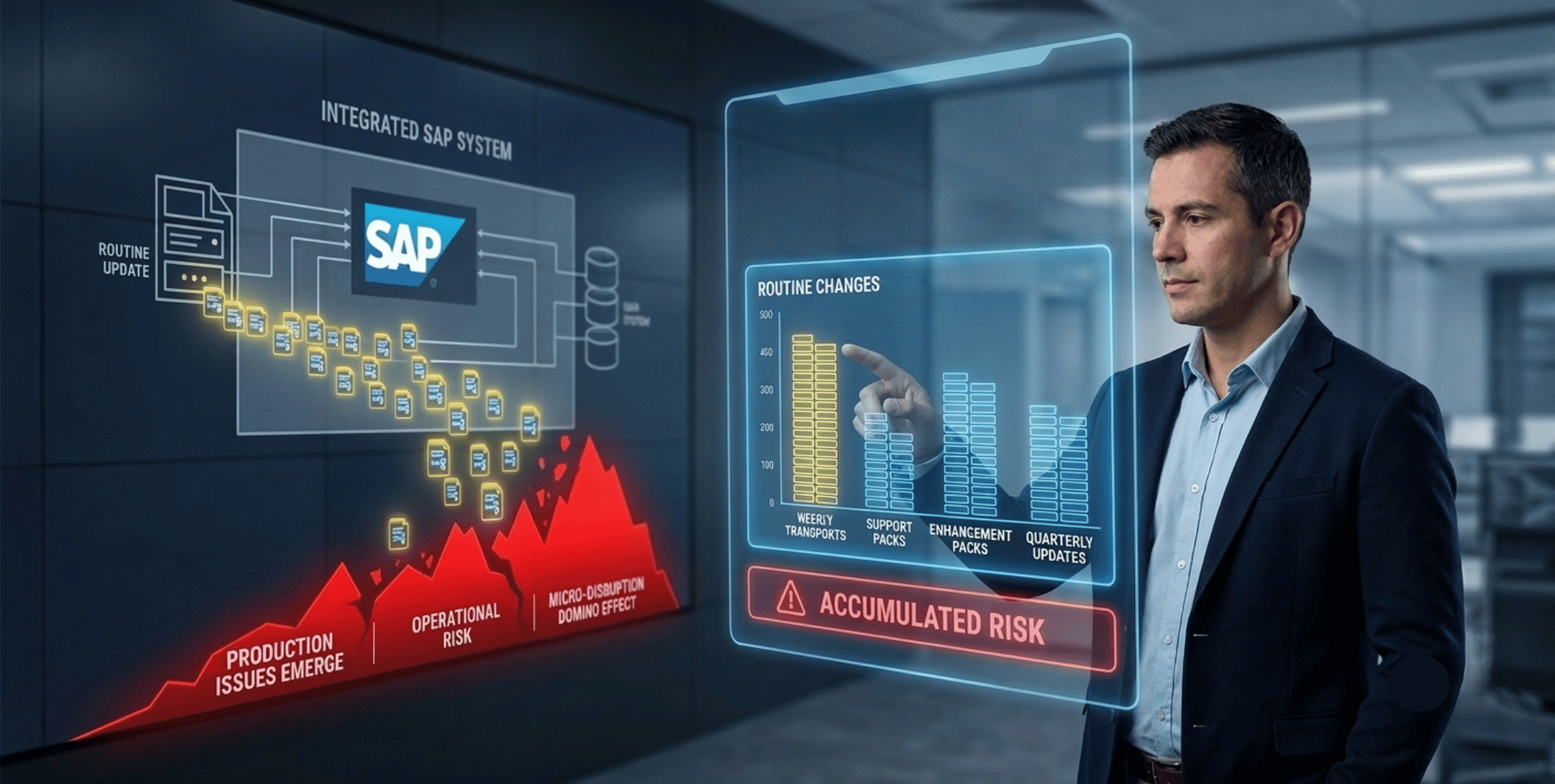
The reality? The assumption that familiar, recurring changes are inherently low-risk is a dangerous illusion. In complex SAP ecosystems, it’s rarely the tsunami that takes you down, it’s the steady accumulation of minor leaks.
The Illusion of the “Routine” Update
In a modern enterprise, an SAP landscape is a living, breathing organism. It is a web of custom code (Z-tables and custom programs), third-party integrations, APIs, and heavily configured business logic.
When a standard support pack or minor transport is introduced, it doesn’t enter a sterile environment. It collides with this custom ecosystem.
Organizations often treat these updates as minor because the individual code changes seem negligible. However, operational risk doesn’t scale linearly; it accumulates. Here is why routine updates routinely cause chaos:
- The Snowball Effect: A minor patch to a core application area might alter a standard function module. You might not use that standard function directly, but three of your critical custom shipping and billing reports do.
- The Psychology of Complacency: Because a team has successfully deployed dozens of transports this year, vigilance drops. Regression testing for a “routine” change is often treated as a checkbox exercise; or worse, it is skipped entirely based on tribal knowledge (“We touch this table all the time, it’ll be fine”).
- Lack of Visibility: Traditional SAP transport management tells you what objects are moving, but it rarely tells you how those objects interact with the rest of your production environment.
The BAU Paradox: The more routine a change feels, the less scrutiny it receives, and the higher its hidden risk profile becomes.
The Micro-Disruption Domino Effect
When a seemingly small SAP change goes wrong in production, the business cost is rarely minor.
Imagine a routine quarterly update that subtly alters a field within the procurement or inventory tables. It passes basic unit testing because the field still accepts inputs. But tomorrow morning, a critical automated supply chain batch job fails because it can no longer parse the updated data format.
Suddenly, warehouses are stalled, orders are delayed, and a team of basis administrators and developers are pulled off their strategic roadmap initiatives to hunt through a haystack of recent transports for a single needle.
This is the hidden cost of BAU. It isn’t just the immediate cost of fixing the bug; it’s the erosion of business velocity, the loss of trust from stakeholders, and the constant operational fire-fighting that keeps your best engineering talent trapped in reactive mode.
Shifting from Blind Faith to Change Intelligence
To break this cycle, organizations must stop treating impact analysis as a luxury reserved only for major upgrades. Every change entering production deserves an accurate risk assessment.
But how do you do that without slowing down delivery velocity? You can’t manually test everything every week.
The answer lies in Change Intelligence and Automated Impact Analysis. This is where Foulk Consulting (FCS) partners with organizations to fundamentally rewrite their approach to SAP maintenance.
Instead of guessing what might break, or attempting to blindly test the entire system, we help organizations leverage data-driven insights to look under the hood before a transport ever leaves the QA environment.
1. Pinpoint Impact Analysis
FCS introduces advanced impact analysis capabilities that scan your exact SAP footprint, including all custom code and usage data. When a support pack or transport is introduced, the system maps the incoming changes directly against your active business processes. It highlights precisely which transactions, reports, and interfaces are exposed to risk.
2. “Smart” Testing (The Delta Approach)
Once you know exactly what is impacted, your testing strategy changes completely. Instead of a massive, slow regression test or an inadequate spot-check, you execute a highly targeted delta test. You test only what is affected, ensuring 100% coverage of the risk area while ignoring the 95% of the system that remains untouched. This dramatically accelerates release cycles while virtually eliminating production incidents.
3. Eliminating the Guesswork
By enhancing expert developers’ and consultants’ judgment with objective, systemic visibility, IT leadership regains control. You gain a clear audit trail of what is changing, what needs to be validated, and exactly when a release is genuinely safe for production.
Rethinking “Business as Usual”
As SAP architectures grow more interconnected and the pace of business demands faster release cycles, the old way of managing routine changes is no longer sustainable.
It is time to reevaluate the assumption that frequent means safe. By implementing proactive change intelligence, you can turn your SAP transport pipeline into a competitive advantage, one where “Business as Usual” actually means predictability, stability, and zero surprises in production.
Want to see exactly where your routine SAP changes are hiding risk? Let’s talk about how Foulk Consulting can bring deep change intelligence and automated impact analysis to your team.