
By Caleb Billingsley, AI Testing and Performance Expert, Foulk Consulting
Every engineering leader and QA director has lived through some version of this post-incident review:
A major release was pushed to production. Within twenty minutes, the support desk lit up with timeouts, spinning wheels, and failed transactions. When the team gathers for the post-mortem, the first defensive line is almost always:
“I don’t understand what went wrong, it passed all acceptance criteria, and it worked perfectly in UAT.”
In modern software delivery, passing User Acceptance Testing (UAT) is a baseline, not a finish line.
Validating that a feature functions correctly in an isolated, low-concurrency test environment only confirms that the software works under ideal, sterile conditions. It tells you nothing about how that application will behave when thousands of concurrent users arrive with unpredictable behavior, un-cached queries, and simultaneous checkouts.
As digital systems become the primary interface of enterprise revenue and customer loyalty, organizations must graduate from simply asking “Does it work?” to rigorously proving “How well does it perform under stress?”
The “Binary Quality” Fallacy
Historically, software quality assurance has operated on a binary premise: Pass or Fail.
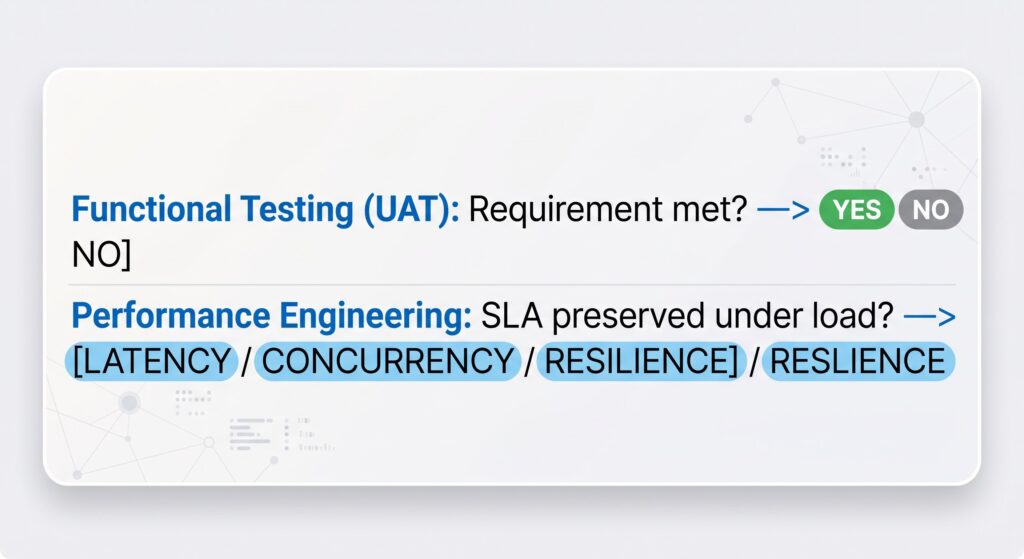
Functional and acceptance testing verify expected business logic:
- Can a user log in?
- Does clicking “Submit Order” write a row to the database?
- Does the discount code apply 15% off?
If the answer to each is “Yes,” the build is stamped with approval.
However, production does not operate as a sequential, single-threaded checklist. Production is an ecosystem of distributed dependencies, shared resource pools, and asynchronous events.
When 5,000 users attempt to apply that discount code within the same 60-second window, the question is no longer whether the calculation works. The real questions are:
- Does connection pool exhaustion lock the database?
- Does third-party payment gateway throttling cascade into microservice timeouts?
- Does garbage collection spike CPU utilization to 99%, dropping active sessions?
3 Real-World Pressures UAT Never Replicates
| Pressure Point | What UAT Sees | What Production Actually Experiences |
| Concurrency & Thread Contention | A handful of QA testers or business analysts executing scripted paths one at a time. | Hundreds or thousands of parallel threads competing for database locks, memory buffers, and I/O channels. |
| Data Volume & Cache Degradation | Freshly seeded staging databases with tidy, optimized sample records. | Multi-terabyte production tables, fragmented indexes, cache misses, and heavy payload transfers. |
| Cascading Latency & Downstream Dependencies | Isolated services and healthy third-party sandboxes responding with sub-second latencies. | Upstream backpressure, exhausted connection pools, and cascading timeouts triggered by a single lagging microservice or external API. |
1. Concurrency and Resource Locking
In UAT, database connection pools are rarely saturated. In production, high concurrency exposes hidden architectural bottlenecks—such as unindexed foreign keys causing table-level locks, thread deadlocks, or thread contention inside message brokers. Functional tests will never catch a lock escalation bug because they rarely fire simultaneous writes on the same database page.
2. The Illusion of Synthetic Test Data
A query that takes 12 milliseconds on a staging database with 10,000 records can take 6.4 seconds when running against a production table with 50 million records. Without realistic data volume and soak testing, teams fail to uncover memory leaks, slow query plans, and degradation over extended operating cycles.
3. Cascading Failures and Downstream Saturation
In UAT, microservices and external dependencies operate in near-isolation with empty queues and instant response times. Production, however, is a tightly coupled web of distributed services, message brokers, and third-party APIs. A minor 200ms latency spike in a downstream payment gateway or inventory lookup doesn’t remain isolated under volume; it causes incoming requests to queue up, exhausting application server thread pools and triggering cascading timeouts across the entire ecosystem. Functional tests cannot validate whether your fallback strategies, circuit breakers, and rate limiters will preserve core system availability when downstream dependencies degrade under pressure.
Modernizing Quality: From Checkbox Testing to Performance Engineering
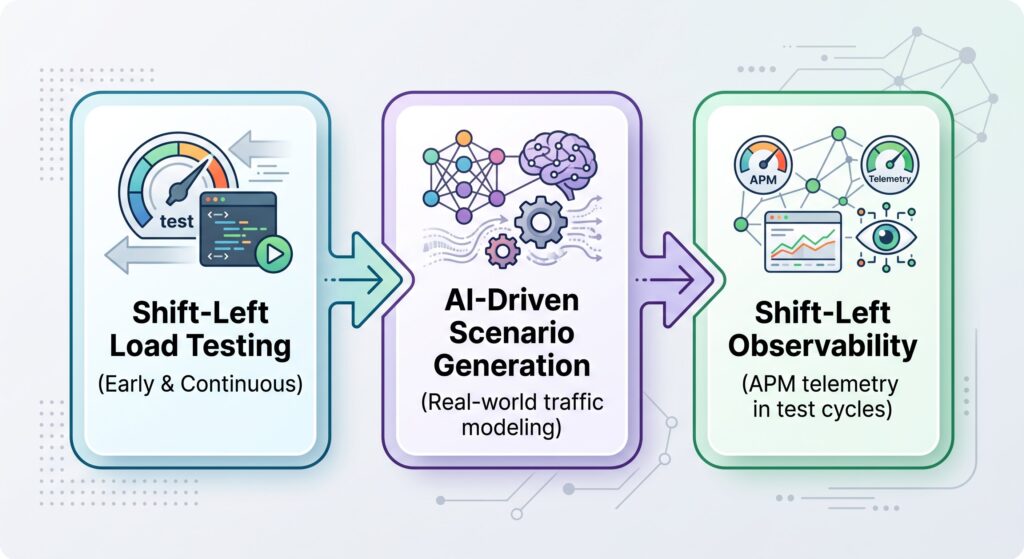
Transforming performance from an afterthought into a competitive advantage requires shifting from reactive, last-minute load testing to an integrated performance engineering culture.
1. Shift Performance Left in the CI/CD Pipeline
Performance testing should not be a multi-week barrier executed once a quarter right before a production release. By integrating lightweight performance and API benchmark tests into early development cycles, engineering teams can catch regressions in latency and memory consumption before code ever merges into main branches.
2. Inject AI and Realistic Workload Modeling
Modern performance engineering utilizes machine learning to analyze production APM logs and user analytics. Instead of testing synthetic “happy paths,” AI models help generate stochastic load profiles that mirror actual user journey distributions, payload variances, and peak-hour anomaly patterns.
3. Pair Load Generation with Full-Stack Observability
Running a performance test without deep observability is just guessing. By embedding Application Performance Monitoring (APM) and distributed tracing tools into test cycles, teams can correlate synthetic traffic directly with CPU thread utilization, microservice latency traces, and database execution plans. This transforms performance testing from a “pass/fail report” into an actionable roadmap for architectural optimization.
The Strategic Bottom Line
Functional testing tells you if your application can work. Performance engineering tells you if your business will succeed under real-world market demands.
When revenue, brand reputation, and operational efficiency are tied directly to digital experience, “it worked in UAT” is no longer an acceptable standard. Quality must encompass speed, scalability, resilience, and user experience under pressure.
At Foulk Consulting, we help enterprise organizations design, automate, and scale performance engineering strategies that safeguard revenue and eliminate production surprises. Ready to elevate your QA practice? Connect with our team at Foulk Consulting.