By Caleb Billingsley, AI Testing and Performance Expert, Foulk Consulting
Every tech vendor on the planet right now wants you to believe their platform is a self-healing, autonomous miracle powered by artificial intelligence. They promise an operational utopia where bugs fix themselves, performance bottlenecks vanish, and your engineers can sleep peacefully through the night.
But if you’ve spent any time in the trenches of performance engineering and software testing, you know the truth: most “self-healing” software is just marketing fluff wrapped around basic automation.
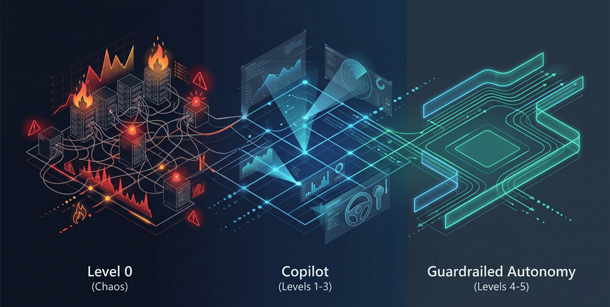
To cut through the noise, we need a clear framework for what AI maturity actually looks like in operations and testing. Borrowing a concept from autonomous driving, let’s break down the journey from manual firefighting to full autonomy, and look honestly at where the industry actually stands today.
Part 0 — Level 0: Before AI
How We “Self-Healed” With Humans, Scripts, and Tribal Knowledge
Before AI entered the conversation, systems still had to stay up. And they did, not because the systems were smart, but because the people running them were.
At Level 0, everything is entirely manual and reactive:
- Monitoring tools fire static, hardcoded alerts.
- Engineers get woken up at 2 a.m. by a pager.
- Someone runs a script they copied from an internal wiki five years ago.
- The system stabilizes, a postmortem is written (maybe), and nothing structural changes.
This wasn’t incompetence; it was just how the industry worked. Long before anyone muttered the words “AIOps,” teams built pseudo self-healing systems using deterministic automation. We wrote cron jobs to restart services if a port stopped responding, configured load balancers to drop unhealthy nodes, and set up database failover scripts.
It was simple: If X happens, do Y. And it worked remarkably well…until it didn’t.
The Classic Failure Mode: Knight Capital (2012)
When Knight Capital deployed new trading software, a dormant flag accidentally triggered obsolete code. Their automated systems executed millions of unintended trades in minutes. The system didn’t “know” it was wrong because it lacked context; it was simply doing exactly what it was told. No AI, no learning—just blind automation. Knight Capital lost $440 million in 45 minutes.
The Takeaway: Level 0 systems don’t fail because they lack AI. They fail because knowledge never compounds. Automation without understanding is fundamentally dangerous.
Part 1 — Level 1: Machine Learning as a Flashlight
Seeing What Humans Can’t
Level 1 is where machine learning (ML) first enters the frame, though it’s frequently mislabeled as true AI. At this stage, systems still don’t make decisions or take actions. Instead, they give humans a clearer view of reality.
| Machine Learning vs. Artificial Intelligence |
| Machine Learning (Level 1): Statistical pattern detection derived from historical data. It answers: What does normal look like? |
| Artificial Intelligence (Level 2+): Systems that use those detected patterns to actively influence decisions or take actions. |
At Level 1, ML acts as an operational flashlight through:
- Baseline Learning: Understanding that a traffic spike at 9 a.m. on Monday is normal, but the same spike at 3 a.m. on Sunday is a problem.
- Noise Reduction: Collapsing 10,000 chaotic alerts into 3 core symptoms.
- Change Correlation: Identifying that a sudden latency jump occurred exactly three minutes after a specific microservice deployment.
A great example of this is Netflix. They didn’t achieve high availability by immediately jumping to autonomous self-healing. They started by investing heavily in telemetry, metrics, and anomaly detection so their engineers could see regional failures early and diagnose subtle degradations before they caused widespread outages. It wasn’t AI running the show; it was ML helping humans understand the system.
Warning: Many enterprises buy an expensive “AI monitoring tool,” turn it on, and end up deeply disappointed. Why? Because ML cannot fix bad instrumentation, missing ownership, or garbage data. ML applied to poor telemetry is like putting night-vision goggles on in a dense fog.
Part 2 — Level 2: AI as a Copilot
From Patterns to Recommendations
Level 2 is where actual AI starts to talk to us more like a person. This isn’t because the underlying models magically became sentient, but because the system finally starts offering a human like voice.
We are shifting from simple pattern recognition to active decision support. At Level 2, the system doesn’t just show you a chart; it suggests root causes, ranks likely contributors, and recommends next steps.
[System Anomaly Detected]
└── AI Analysis: “This slowdown is 94% correlated with DB lock contention.”
└── Recommendation: “95% of similar past incidents were resolved by scaling dependency X.”
└── Action: [Awaiting Human Input]
This is incredibly powerful, but it relies entirely on human trust. Think of modern aviation. Advanced aircraft systems can detect anomalies, recommend corrective actions, and even prevent pilots from making unsafe maneuvers. Yet, the pilots remain the final decision-makers. This intentional division of labor is exactly why commercial flying is statistically safer than ever.
Part 3 — Level 3: Human-Approved Automation
AI as an Operator
At Level 3, organizations begin to experience true operational leverage. The AI stops acting as a passive advisor and starts behaving like an assistant operator. It initiates the fix, but waits for a human to turn the key.
The jump from Level 2 to Level 3 looks like this:
- AI detects an early performance regression during a canary deployment.
- It automatically spins up targeted load tests to isolate the issue.
- It packages the diagnostics, proposes a rollback, and flags the lead engineer.
- The engineer clicks “Approve.”
- The AI safely executes the rollback and verifies system stability.
This is assisted execution, not pure self-healing. It mirrors modern clinical medicine, where decision-support systems flag abnormal lab results and suggest specific treatments, but a physician must sign off on the prescription.
The primary risk at Level 3 is operational laziness. If your runbooks are outdated or your team treats approvals as a thoughtless rubber-stamping exercise, bad automation will simply scale your mistakes faster. But when executed correctly, Level 3 is where Mean Time to Resolution (MTTR) plummets and performance stops being a late, painful surprise.
Part 4 — Level 4: Guardrailed Self-Healing
Automation With Accountability
Level 4 is what most vendors are actually selling when they pitch “self-healing.” However, it is far less magical and far more disciplined than the marketing brochures suggest.
At Level 4, the system has permission to act without asking, but only within strictly defined boundaries and known failure modes.
We see successful Level 4 behaviors every day in standard cloud infrastructure:
- An EC2 node dies, and an auto-scaling group replaces it.
- An Availability Zone degrades, and traffic is automatically rerouted.
- A microservice is overwhelmed, and a circuit breaker trips to preserve the database.
Ironically, most of these foundational behaviors don’t require AI; they require solid architectural policy. The “AI” layer at Level 4 comes into play by intelligently adjusting those guardrails over time rather than relying on static thresholds.
The danger of Level 4 is silent performance debt. If a system is constantly “self-healing” a memory leak by restarting containers every hour, it might mask a severe architectural flaw. Self-healing that hides the root cause isn’t healing at all, it’s denial. This is why continuous performance testing is mandatory; you have to test the healing logic itself to ensure it doesn’t cause catastrophic cost explosions under sustained load.
Part 5 — Level 5: Full Autonomy
AI as the System Owner
Level 5 is the absolute peak of maturity: full operational autonomy. There are no approvals, no human interventions, and no manual guardrails. The system continuously detects, decides, acts, and learns from its own outcomes. At this stage, humans define the high-level business policies (e.g., “Maintain a 99.9% uptime while minimizing cloud spend”), and the AI figures out how to execute it.
Today, Level 5 works exceptionally well in specific, narrow domains:
- High-frequency algorithmic trading
- Real-time ad bidding networks
- Instantaneous fraud detection engines
These environments share critical traits: they handle high data volumes, feature split-second feedback loops, operate on clear success metrics, and their individual decisions are highly reversible.
For the vast majority of enterprise IT ecosystems, like core banking, healthcare, or global supply chains, Level 5 is not just impractical; it’s reckless. These systems have a low tolerance for error, immense regulatory burdens, and incredibly complex causality.
Final Thought: AI Maturity Is About Delegated Authority
The biggest mistake organizations make with AI operations isn’t overestimating the technology—it’s failing to decide how much authority they are actually willing to delegate.
[Level 0: No Autonomy] ──> [Level 1/2: Decision Support] ──> [Level 3/4: Delegated Authority] ──> [Level 5: Full Autonomy]
AI shouldn’t be brought in to replace your engineers. It should be deployed to eliminate indecision, delays, and operational inconsistency. The most dangerous systems aren’t the ones running completely autonomously at Level 5; they are the lower-level systems pretending to be intelligent without anyone clearly understanding who is actually holding the wheel.
Where does your organization sit on the AI maturity scale? If you’re ready to move from reactive firefighting to engineered, guardrailed performance, let’s talk about building a strategy that actually scales. Contact us today.