By Miguel Pacheco, SAP Principal Engineer at Foulk Consulting
The promise of modern SAP, whether you are operating on S/4HANA Cloud Public Edition, Private Edition, on-premises, or in a hybrid landscape, is continuous innovation. New capabilities, regulatory adjustments, and performance optimizations arrive on structured, predictable cadences.
For enterprise QA and release engineering teams, however, that predictability often feels like a relentless treadmill.
When an SAP release drops, teams frequently find themselves trapped in a reactive loop: hundreds of automated test scripts suddenly fail, not because underlying business logic broke, but because UI elements shifted, standard fields reorganized, or integration contracts subtly evolved. Instead of spending release windows validating high-risk business flows, engineers spend weeks triaging false positives and manually rewriting brittle scripts.
To break this cycle, we have to rethink how we build SAP test suites. Automation cannot be treated as a recorded record of user clicks; it must be engineered as an adaptable, decoupled system designed to withstand continuous change.
The Root Cause: Why Traditional SAP Automation Breaks
Most legacy automation suites fail during upgrades because of three fundamental design flaws:
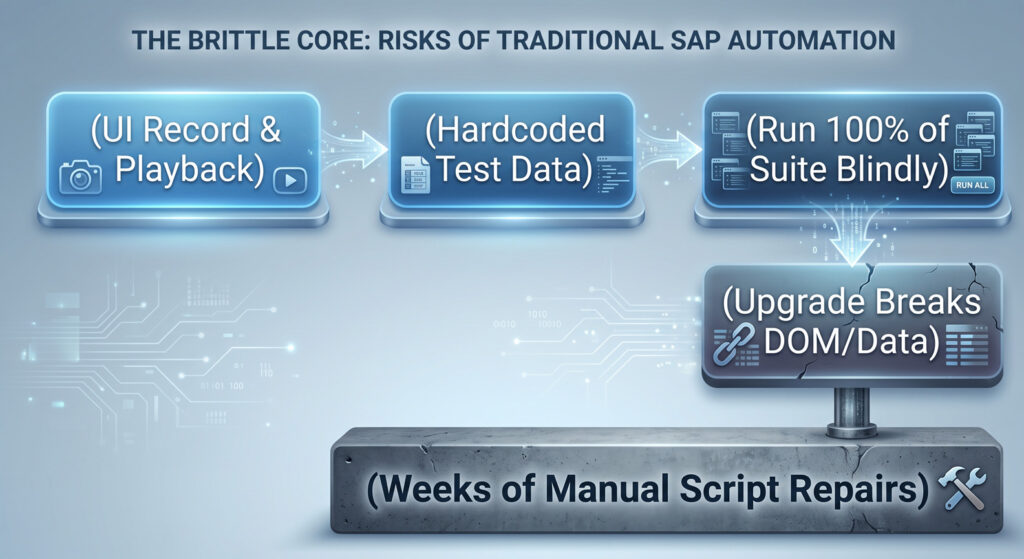
- Tight Coupling to the UI Layer: Traditional record-and-playback tools capture deep DOM paths in SAP Fiori or specific coordinate controls in SAP GUI. A minor UI enhancement in a quarterly update breaks the locator, triggering a false fail.
- Monolithic Script Construction: Scripts written as single, 300-step end-to-end workflows (e.g., Order-to-Cash spanning master data creation to invoice clearing) lack boundaries. A failure at step 12 halts the entire run, obscuring whether the remaining 288 steps actually work.
- Brute-Force Execution: Running an entire regression library of thousands of tests against every maintenance pack or release update is inefficient. Without change-intelligence, teams waste compute and triage time testing modules that SAP didn’t touch.
Aligning Quality with “Clean Core” and SAP BTP
SAP’s overarching architectural standard is the Clean Core strategy: keeping the ERP standard, avoiding modifications to core code, and placing custom business logic, integrations, and extensions side-by-side on SAP Business Technology Platform (BTP).
Your automated test architecture must mirror this separation of concerns:
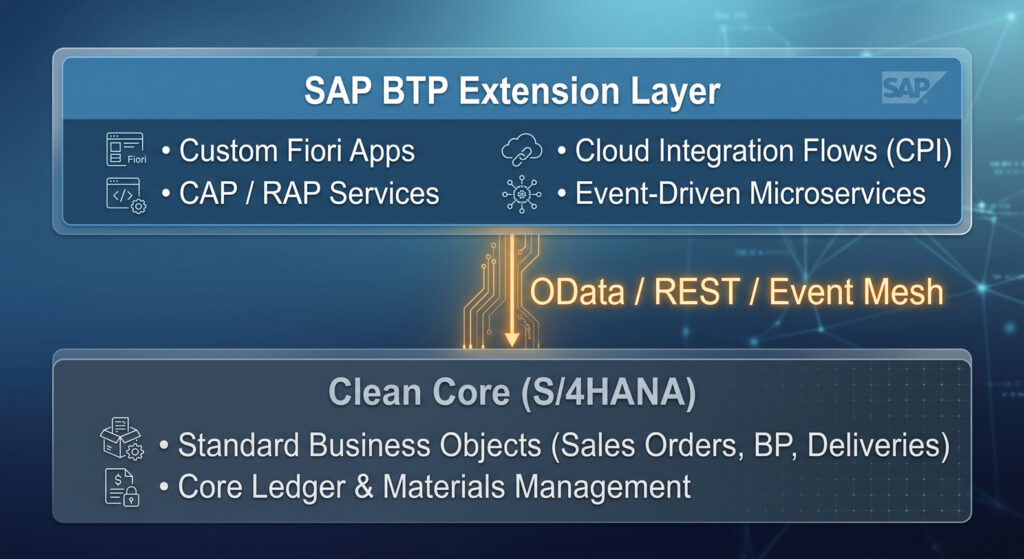
When custom logic resides on BTP and communicates with the core via standard APIs (OData, RFC, REST) and events, validation should occur at those exact interface boundaries.
- Test BTP extensions independently: Validate business logic in the cloud tenant using mock services and contract testing before validating against the integrated backend.
- Isolate Core standard processes: Verify standard transactions using stable API layers and headless validations before validating UI rendering.
The 3 Pillars of an Upgrade-Proof Automation Strategy
Building a resilient SAP test engine requires three foundational disciplines:
1. Modular, Component-Based Frameworks
Deconstruct linear workflows into discrete, reusable business components. Instead of 50 different scripts each containing steps to create a sales order, maintain one single, parameterized “Create Sales Order” module.
- Page Object / Screen Abstraction: Isolate UI locators from test logic. When SAP updates a Fiori tile or screen layout, you update the selector in one central repository, instantly fixing every test that touches that view.
- Headless & API-First Steps: Wherever human interaction isn’t strictly required (such as seeding prerequisite test data or verifying background postings), execute via standard SAP APIs (BAPIs, OData) rather than driving the browser. This speeds up execution by orders of magnitude and eliminates UI fragility.
2. Risk-Based Testing (RBT) via Change Impact Analysis
Upgrade validation should be surgical, not exhaustive. By analyzing the exact payload of an incoming SAP release (transports, modified CDS views, altered authorization objects, updated Fiori catalogs), you can map code changes directly to affected business processes.
| Capability | Traditional Approach | Modern Risk-Based Approach |
| Scope Definition | Run 100% of the regression library | Target the top 15–20% of impacted, critical paths |
| Triage Time | Weeks spent sorting false failures | Hours focused on verified functional anomalies |
| Release Confidence | Based on raw test volume completed | Based on explicit risk coverage and defect containment |
3. Dynamic & Synthetic Test Data Orchestration
Hardcoded master data (fixed vendor numbers, static plant codes, single-use materials) is a silent killer of automated suites. When tenant data refreshes or locks post-upgrade, entire suites fail.
- Embed dynamic data creation routines at the start of execution cycles.
- Utilize automated API calls to generate fresh transactional records on the fly, execute the test assertion, and trigger archiving/reversal where appropriate.
The Modern Quarterly Release Validation Workflow
When an SAP upgrade hits your non-production tenant, the automation lifecycle should execute predictably across four phases:
- Phase 1: Delta Assessment: Run change impact analysis against Support Packages (SPs), Transport Requests (TRs), and relevant SAP Notes to identify altered standard transactions, custom BTP dependencies, and impacted security roles.
- Phase 2: Targeted Core Smoke Suites: Trigger modular API and headless integration tests across high-risk business flows to verify core processing integrity.
- Phase 3: BTP & End-to-End Integration Runs: Execute automated UI and cross-system flows (e.g., Salesforce → BTP → S/4HANA → Third-Party WMS) with centralized model-based test assets.
- Phase 4: Focused Defect Remediation: Address real system defects flagged by risk-weighted runs, bypassing maintenance noise.
Making Upgrades Non-Events
Automating SAP shouldn’t create a secondary maintenance burden that swells with every release cycle. By structuring automation into modular components, leveraging API-level validation, and focusing execution through change impact intelligence, engineering teams can turn upgrade validation into a streamlined, repeatable process.
At Foulk Consulting, we partner with enterprise organizations to replace brittle scripts with durable quality engineering frameworks, empowering teams to adopt continuous S/4HANA innovation with confidence.