
By Nate Rich, Principal Engineer, Foulk Consulting
In the world of enterprise IT, we are conditioned to view “migration” as a technical hurdle. We treat it like a hardware refresh or a database cutover: move the data, verify the connection, and turn off the old system. When the last agent is installed and the data starts flowing into the New Relic platform, the project manager checks the box, the budget is closed, and the team moves on to the next fire.
But if you ask an IT leader six months later if the migration was a success, the answer is often a hesitant, “Well, we’re using it.”
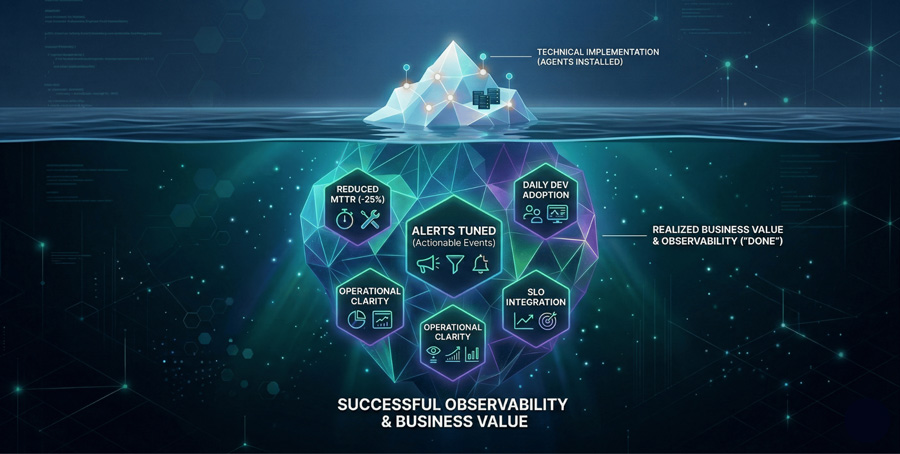
That hesitation exists because “Installed” and “Done” are not the same thing. Instrumentation is a technical milestone; observability is an organizational capability. If you want to see a true return on your New Relic investment, you have to define success by outcomes, not by activity.
Here is what a successful New Relic migration actually looks like when it is truly “Done.”
1. The “Mean Time” Metrics Are Moving
The primary reason organizations move to a platform like New Relic is to stop guessing and start knowing. If your migration is successful, your operational metrics should reflect that clarity.
- MTTR (Mean Time to Repair) is down: Success looks like a 20% or 30% reduction in the time it takes to resolve an incident. Why? Because developers are no longer hunting through disparate logs; they are looking at a distributed trace that points exactly to the failing service.
- MTTD (Mean Time to Detect) is shrinking: If your “Done” criteria include proactive alerting and AI-driven anomaly detection, you should be catching issues before they impact the end user.
If your agents are installed but your bridge calls are still lasting four hours, the migration isn’t finished.
2. Observability Is a Daily Habit
A platform is only as good as its adoption. I’ve seen organizations spend millions on licensing, only to have three “power users” who actually know how to navigate the dashboards.
True success looks like:
- Daily Logins: Are your developers logging into New Relic every morning? Are they checking the health of their services as part of their daily stand-up?
- Self-Service Dashboards: When a Product Manager asks about the performance of a new feature, can the engineering team pull up a dashboard instantly, or do they have to “get back to you next week” after running manual queries?
- The “One Source of Truth”: Success is when the Operations, Engineering, and Product teams are all looking at the same screen during an incident, rather than arguing over whose data is correct.
3. Service Level Objectives (SLOs) Are Integrated
Too often, migrations focus on “Red/Green” health checks. But IT leaders need to know how technical performance impacts business goals.
A successful migration means your technical metrics are mapped to business outcomes. You should be able to see exactly how a 500ms spike in latency on a specific API correlates to cart abandonment or user churn. When your New Relic instance is providing a clear view of your SLOs and Error Budgets, you have moved from “monitoring” to “strategic observability.”
4. The “Noise” Has Been Silenced
Installing agents is the easy part. Tuning them is where the value lives. A common failure in migrations is “Alert Fatigue,” where the new system sends so many notifications that the team eventually ignores them all.
“Done” looks like a refined alerting strategy. It means that when an engineer gets a page at 2 AM, it is for a high-priority, actionable event that actually requires their attention. If your team is still filtering through thousands of “informational” alerts, the migration is still in progress.
The Foulk Consulting Perspective: Defining the Finish Line
At Foulk Consulting, we help IT leaders understand that New Relic is not a “set it and forget it” tool. It is an engine for cultural change.
If you are currently planning or in the middle of a migration, I encourage you to stop looking at the deployment map and start looking at your KPIs. Ask your teams: “What will we be able to do on Tuesday that we can’t do today?”
If the answer is just “see more charts,” you aren’t there yet. If the answer is “reduce our downtime by half and give our developers two hours of their day back,” then you are on the path to being truly “Done.”
Need help defining your observability roadmap? Foulk Consulting specializes in ensuring your migrations deliver measurable business value.

*** Nate Rich is a Principal Engineer at Foulk Consulting, where he helps enterprises master performance engineering and full-stack observability.
