When performance bottlenecks hit production, Application Performance Monitoring (APM) tools are invaluable for pointing out where the fire is. But why are we waiting for the alarm to sound at 2:00 AM?
In our recent live webinar, Caleb Billingsley (Head of Performance Testing at Foulk Consulting) teamed up with Shane Evans (Product Leader at Perforce / BlazeMeter) to tackle the “Reactive Trap” and how modern teams can shift from troubleshooting production disasters to proactively predicting them.
If you missed the session or want to share the practical strategies with your engineering and QA teams, you can watch the full recording below:
The Reality: The Cost of the “Reactive Trap”
With the growth of cloud environments, microservices, and CI/CD pipelines, a tempting narrative emerged: “If something breaks in production, we’ll just roll it back or let APM alert us.”
However, the cost of that assumption is astronomical. High-impact outages and performance degradation lead to war-room finger-pointing, brand erosion, and direct revenue loss.
According to New Relic’s Observability Forecast, downtime costs large enterprises between $1 million to $5 million per hour.
Waiting for production users to uncover scalability bottlenecks is not a performance strategy, it’s a liability.
Key Takeaways from the Session
During the webinar, Caleb and Shane walked through how modern performance engineering combines APM observability with automated load testing and AI to build an active feedback loop.
1. Connecting Load Testing with APM (The Closed Feedback Loop)
APM shouldn’t live in an isolated production silo. By instrumenting your pre-production and performance testing environments with the same APM agents used in production (e.g., Dynatrace, New Relic, AppDynamics, Datadog), teams can:
- Predict behavior under load before real user traffic ever touches the system.
- Establish consistent baselines across sprints to catch regressions early.
- Correlate load spikes with code bottlenecks (down to the database query or thread lock) in controlled environments.
2. Putting “AI in the Loop”
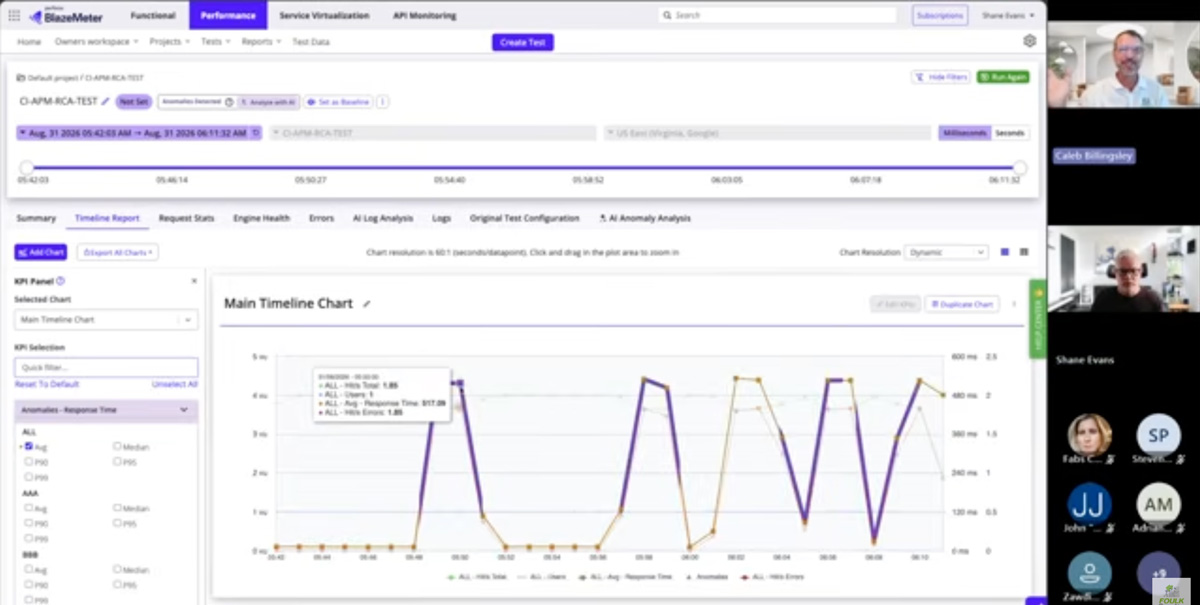
Shane showcased how AI is transforming performance analysis. Rather than sifting manually through gigabytes of logs and performance metrics across disparate dashboards, AI-assisted anomaly detection and intelligent log summarization can pinpoint root causes in seconds.
3. Managing AI & Cloud Cost Efficiency
A major topic during the live Q&A addressed controlling costs when testing complex, AI-driven architectures. Caleb and Shane discussed:
- Service Virtualization: Mocking costly backend APIs and LLM calls during high-volume load tests so you test application stability without running up third-party compute bills.
- Prompt Optimization & Token Controls: Practical ways to prevent engineering teams from “token maxing” when integrating LLM workflows into test pipelines.
Ready to Modernize Your Performance Strategy?
Whether you are looking to integrate APM diagnostics into your pre-release pipelines, modernize your load testing with BlazeMeter, or ensure your applications scale under peak demand, Foulk Consulting is here to help.
- Watch the Webinar Recording
- Get in Touch: Reach out to our performance engineering team at Foulk Consulting to schedule a performance assessment or explore our training workshops.