By Miguel Pacheco, SAP Principal Engineer at Foulk Consulting
In enterprise IT, “DevOps” is easy to put on a PowerPoint slide. But inside a traditional SAP shop, making it a reality is notoriously painful.
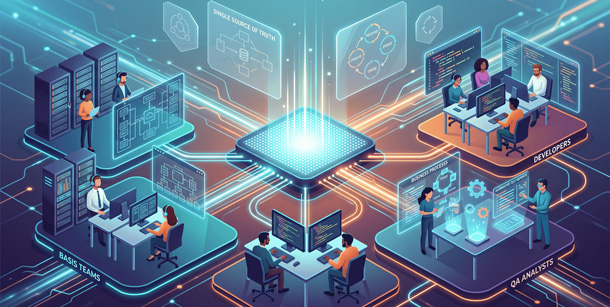
For decades, SAP delivery has operated in distinct, heavily fortified silos:
- Basis engineers live in transport management logs, system monitoring, and landscape maintenance.
- ABAP and BTP developers live between the classic ABAP Workbench, Eclipse, VS Code, and code repositories, focused on shipping business logic and custom extensions.
- QA analysts and test leads live in testing repositories and defect trackers, burdened with validating complex end-to-end business processes.
- Release Managers and Change Advisory Boards (CABs) sit trapped in endless weekly triage calls, cross-referencing spreadsheets to figure out what is actually safe to move to production.
When release cycles stall, or when an unvetted transport brings down order processing on a Monday morning, the finger-pointing begins. Developers claim QA tested the wrong scope; QA notes Basis imported transports out of sequence; Basis argues that the CAB signed off without full visibility into dependency risks.
The real culprit isn’t incompetent tooling or indifferent teams. It is the absence of a shared operational source of truth.
As we help organizations modernize their delivery architectures, one reality has become undeniable: SAP Cloud ALM is not just an operational dashboard or a cloud-native replacement for Solution Manager, it is the cultural bridge that makes modern, collaborative SAP DevOps possible.
The Root Cause: Why Traditional SAP ALM Created Silos
Legacy ALM platforms, most notably SAP Solution Manager (SolMan) paired with ChaRM, were architected around control, compliance gates, and heavy governance. While they served their purpose in an era of monolithic, quarterly release cycles, they suffered from significant structural drawbacks:
- High Administrative Burden: The overhead of managing projects, documentation branches, and transport decouple/re-couple workflows turned the ALM tool into an administrative bottleneck rather than an agile delivery accelerator.
- Disconnected Validation: Testing and validation were treated as isolated phases at the very end of the cycle for a “test everything and pray” marathon instead of targeted, risk-based validation.
- Data Fragmentation: Different teams maintained their own truth. User stories lived in Jira, service requests in ServiceNow, test scripts in spreadsheets or standalone test tools, and transports inside STMS.
This friction created a culture of defensive engineering. Teams protected their turf with manual approval gates, driving deployment velocity down and release anxiety up.
The Foundation: End-to-End Traceability by Design
To break down cultural barriers, you must eliminate the ambiguity surrounding what is being built, why it is being built, and how it is verified. SAP Cloud ALM achieves this through native, bidirectional traceability from business requirements down to individual transport units and test runs.
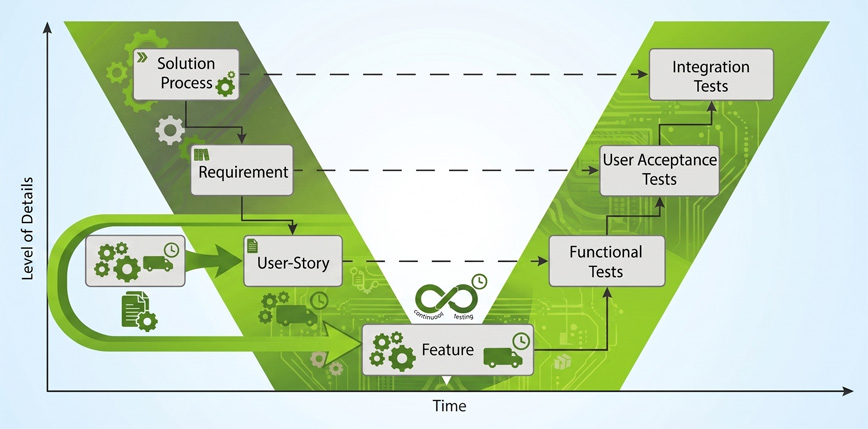
When your entire delivery pipeline is anchored to this flow, every role gains immediate context:
- Solution Processes & Requirements: Define the business intent and scope upfront.
- User Stories & Tasks: Translate business scope into actionable sprints for functional and technical leads.
- Features & Transports: Encapsulate the technical deliverables (on-premise ABAP transports, S/4HANA Cloud changes, or SAP BTP deployments).
- Tiered Validation (Functional, UAT, Integration): Ensure test cases are directly coupled to the specific user stories and features they protect.
How SAP Cloud ALM Bridges the Cross-Functional Divide
When Basis, Development, and QA all interact within an open, integrated platform, daily dynamics shift from defensive status reporting to proactive collaboration.
| Persona | Traditional Siloed Experience | Collaborative Reality in SAP Cloud ALM |
| Basis & Ops | Manual transport “traffic cops”; blamed when import sequences fail or dependencies break in QA/Prod. | Automated deployment pipelines with real-time dependency checks, tenant health monitoring, and clear transport sequencing. |
| Developers | Write code in isolation; discover breaking regression issues or missing dependencies late in the release cycle. | Direct linkage between user stories, clean core extensions, and transport features with instant feedback from automated test runs. |
| QA & Testers | Struggle to know what code actually changed; forced into bloated regression marathons before every release window. | Precision validation based on change scope; automated execution tracking tied directly to requirements and features. |
| Release Managers | Endless spreadsheet reconciliation and manual Change Advisory Board interrogation meetings. | Single pane of glass showing feature readiness, passing test metrics, and deployment risk in real time. |
1. Developers and QA: From Antagonists to Continuous Validation Partners
In a disjointed environment, QA is often viewed as the “department of slowing things down.” When QA finds a defect days before cutover, developers are forced into panic mode to provide emergency transports.
Within SAP Cloud ALM, validation shifts from a reactive gate to continuous verification. Because test cases and automated scripts are mapped directly to User Stories and Features, QA analysts know the exact operational footprint of every change. Paired with automated change-impact analysis tools (like Tricentis LiveCompare), QA can run targeted, surgical test suites within hours instead of waiting weeks for full regression passes.
2. Basis and Developers: Eliminating the “Transport Black Box”
For Basis administrators, the greatest headache has always been uncoordinated transports arriving in the queue without clear ownership, sequence rules, or functional testing sign-offs.
Cloud ALM’s Feature Management acts as the contract between Dev and Basis. A Feature wraps all associated development objects, configuration changes, and transports into a single deployable artifact. Basis engineers no longer need to guess whether a transport is ready for Pre-Prod or Production—the system enforces that all mandatory test runs, code checks, and approvals are satisfied before the feature can be promoted.
3. Business Owners and IT: Transparent Audit and Release Readiness
Compliance and audit validation in regulated environments (such as Life Sciences, Manufacturing, and Financial Services) typically require weeks of manual evidence collection.
With Cloud ALM, traceability is an organic side effect of doing the work. When an auditor or business stakeholder asks for proof of test coverage, change approval, and transport history, the entire lineage is visible in a few clicks with no frantic screenshotting or documentation post-mortems required.
Shifting from “Police State” Governance to Continuous Guardrails
The ultimate goal of adopting SAP Cloud ALM is not simply to retire legacy SolMan hardware—it is to replace rigid, manual governance with automated guardrails.
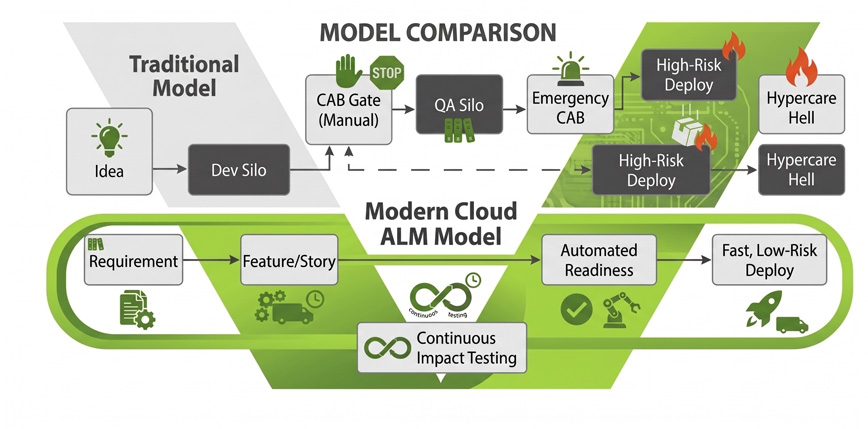
When governance happens continuously in the background:
- Release cycles accelerate: Organizations transition from sluggish quarterly updates to bi-weekly or on-demand sprint deployments.
- Hypercare is eliminated: Production disruptions drop significantly because dependencies and impact risks are caught in sprint zero and development stages.
- Clean Core principles are reinforced: Teams maintain cleaner systems by enforcing standard extension patterns and transparent technical documentation across SAP BTP and S/4HANA.
Making the Shift with Foulk Consulting
Transitioning your enterprise to SAP Cloud ALM is far more than a data migration—it is a transformation of your engineering operating model. Tooling alone cannot fix a broken process, but the right platform combined with modern validation practices will unlock the agility your business demands.
At Foulk Consulting, we help enterprise SAP teams design and deploy integrated ALM toolchains that unite people, processes, and automation. Whether you are planning your SolMan sunset roadmap, modernizing your test automation frameworks, or building a high-velocity SAP DevOps pipeline, our team brings the architectural depth and real-world experience to make it happen.
Ready to modernize your SAP delivery lifecycle? Connect with our team at Foulk Consulting to build a pragmatic, high-velocity ALM strategy.