By Caleb Billingsley, AI Testing and Performance Expert, Foulk Consulting
For years, performance engineering carried a simple, high-stakes value proposition: prevent the catastrophic outage.
We pointed to the high-profile eCommerce crashes on Black Friday or the banking app blackouts during peak hours to justify our budgets. The pitch to executive leadership was effectively an insurance policy to invest in performance testing now so you don’t end up in the headlines tomorrow.
Previously, I’ve written about the importance of bridging the gap between engineering and executive leadership by teaching C-level executives how to interpret observability data. But as organizations have migrated en masse to the cloud and embraced auto-scaling infrastructure, the nature of the conversation has shifted dramatically.
Today, systems rarely “crash” in the traditional sense when load spikes. Instead, cloud providers do exactly what you pay them to do: they automatically provision more compute instances, spin up additional containers, and allocate extra memory to absorb the load.
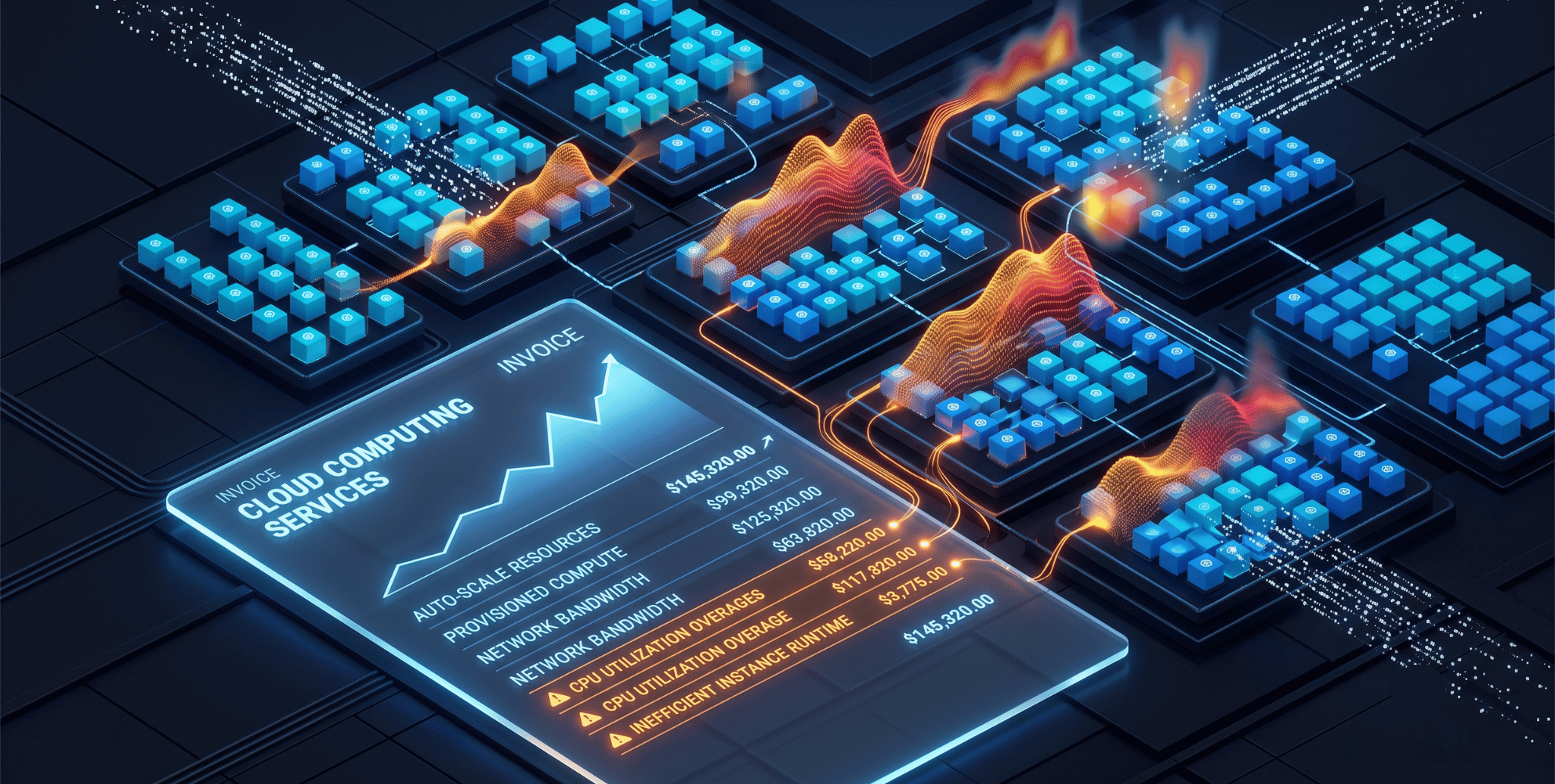
The application stays up. The customer experience remains intact. But behind the scenes, a new problem emerges: your cloud bill explodes.
In the modern enterprise, performance engineering is no longer just a technical safety net. It is one of the most effective financial control strategies an organization can deploy.
The Auto-Scaling Trap: How Modern Cloud Architecture Masks Inefficiency
In an on-premises data center, capacity was fixed. If an unoptimized database query or a subtle memory leak hit production, CPU utilization spiked to 100%, queue lengths built up, and users experienced timeouts. The failure was loud, obvious, and immediate.
In a cloud-native Kubernetes environment, that same inefficient code acts like a silent financial leak.
When inefficient code requires 30% more CPU overhead to process a single transaction, the cloud platform doesn’t throw an error; it spins up 30% more pods. What used to be a performance incident has transformed into a recurring operational expenditure.
Because the application continues to run without triggering traditional availability alerts, leadership assumes everything is fine, until the monthly AWS, Azure, or Google Cloud invoice arrives. By then, thousands (or hundreds of thousands) of dollars have already been burned supporting code friction.
Bridging the Gap: Connecting Observability to FinOps
To get the C-suite to care about performance engineering before the bill arrives, we must translate technical friction into financial impact. This requires aligning modern performance management with FinOps principles.
When we look at observability data through a financial lens, standard engineering metrics take on a whole new meaning:
- p95 / p99 Latency isn’t just a measure of responsiveness; it’s a direct indicator of worker node retention times and thread concurrency limits.
- CPU and Memory Spikes aren’t just resource bottlenecks; they are the direct trigger for horizontal pod autoscalers (HPA) to pull down high-cost compute nodes.
- Database Query Overhead isn’t just slow execution; it’s an over-provisioned RDS instance running at a higher tier than necessary.
The Math Behind the Friction
Consider a microservice processing 20 million transactions per day. If a performance tuning effort reduces the average transaction processing time by just 120 milliseconds and cuts memory utilization by 15%, the immediate result isn’t just a faster user experience.
It means that at peak volume, the application requires fewer concurrent container instances to serve the exact same traffic. Over the course of a year, that minor optimization directly cuts tens of thousands of dollars from the infrastructure baseline.
When you present performance improvements to a CFO as a direct reduction in cost per transaction, performance engineering ceases to be viewed as a “nice-to-have engineering cost” and becomes a high-ROI financial control.
Proactive vs. Reactive: Leveraging AI and Continuous Performance Testing
Waiting for the cloud invoice to identify performance bloat is the most expensive way to manage infrastructure. To stay ahead, teams must integrate continuous, AI-driven performance testing into their early development pipelines.
By combining shift-left performance validation with AI-assisted telemetry analysis, organizations can:
- Benchmark Cost per Transaction early: Measure the infrastructure footprint of new code releases in pre-production environments before they reach auto-scaling production clouds.
- Detect Cost Anomalies in Build Pipelines: Identify subtle increases in CPU cycle consumption or memory footprints that would trigger auto-scaling if deployed at scale.
- Automate Root-Cause Analysis: Use AI observability tools to pinpoint the exact class, query, or API call causing the resource inefficiency, enabling developers to remediate before release.
The Bottom Line
Application friction is no longer just a technical issue, it’s an invisible tax on your organization’s bottom line.
If your leadership team only pays attention to performance engineering after an outage or after a shocking cloud bill, it’s time to change the narrative. By applying FinOps principles to observability data and embedding intelligent performance engineering into your delivery lifecycle, you can prove a clear, undeniable business ROI: optimized code equals leaner, more predictable cloud spend.
Interested in transforming your performance engineering into a cost-saving, high-reliability engine? Contact Foulk Consulting to learn how our AI-driven testing and optimization strategies can help your enterprise maximize performance while controlling cloud spend.